








Since companies realized that they could delegate certain functions to a third party without much risk, the outsourcing model has begun to develop at a rapid pace around the world. The global outsourcing services market has already reached approximately USD 1.09 trillion, and continues to grow through 2030 at a CAGR of roughly 6.4%. This demonstrates sustainable expansion of the industry, not just a short-term surge in demand. Businesses are actively turning to the trusted outsourcing partners not only to optimize costs, but mostly to accelerate growth and remain flexible and resilient in uncertain economies.
For Small and Medium-sized Enterprises (SMEs), understanding the benefits of outsourcing and some challenges related to this model is crucial knowledge that may have a deep impact on the company’s short- and long-term growth.
What is Outsourcing?
Ok, let’s start with an easy one. Unless you’ve been working on a highly confidential projects through the last decade, you must have come across the concept of outsourcing a gazillion times by now.
In simple words, outsourcing means hiring a third-party company (usually niche, industry-specific experts) that handles certain tasks for another business. Delegating a specific set of activities to an external provider enables organizations to focus on core functions and trim operational costs, to mention some of the most basic reasons why SMEs rely so heavily on these trustworthy partners.
Given that external providers may offer superior services at a more favorable price point, outsourcing becomes a viable option across a spectrum of functions, including back-office tasks, software engineering, customer support, marketing, and beyond.
In essence, outsourcing emerges as a strategic tool for bolstering business resilience. Instead of maintaining a full-time, in-house workforce that would require ongoing training and HR assistance, organizations can outsource well-defined functions to specialists who can execute them through an efficient, goal-oriented structure. This is just one example of the multiple benefits of outsourcing that are available to decision-makers.
Proven Advantages of Outsourcing
Companies turn to outsourcing partners for a reason, as the outsourcing model offers plenty of advantages for small businesses and enterprises alike. Let’s take a look at the most significant ones.
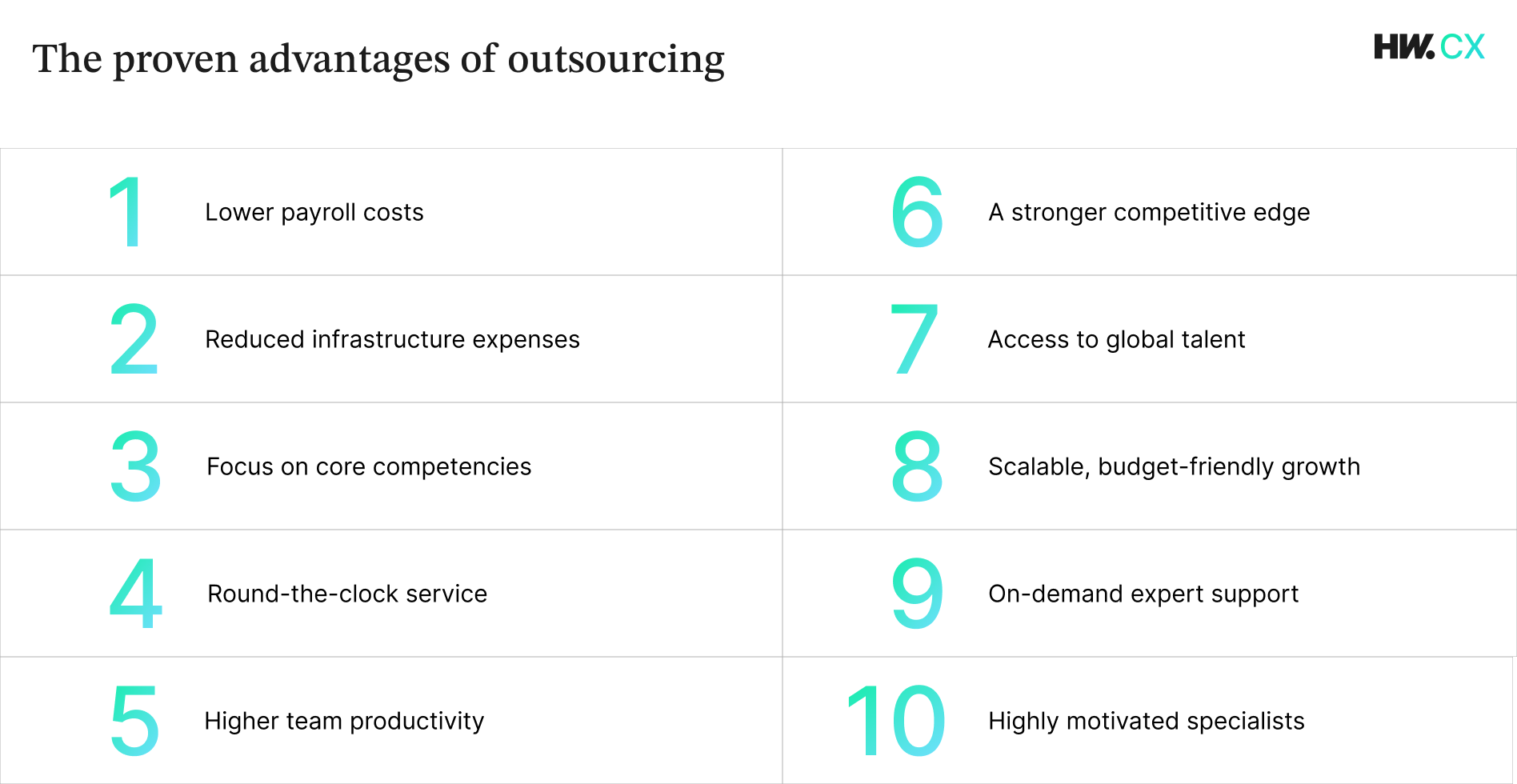
Lower payroll costs
For many businesses, the workforce constitutes one of the most substantial expenses. Salaries continue to rise, and the actual cost of employment extends beyond the weekly paycheck, encompassing expenses like training, healthcare, travel, and additional perks. If you are outsourcing certain activities, you can tap into the expertise without having to manage the specialists directly.
Reduced infrastructure expenses
When it comes to digital-based providers, such as cloud-based services, the cost of maintaining and optimizing both hardware and software tools can be overwhelming for starting businesses. A trusted outsourcing partner takes the heavy lifting with tech, freeing your time to focus on strategy and business development.
Focus on core competencies
As in everything else, running a business is, first and foremost, about setting priorities. What is more important: handling small tasks and spreading your attention thin, or focusing on strategic planning and looking confidently into the future? Most businesses answer this question clearly, choosing the second option. In such a situation, there is nothing left to do but delegate minor processes to other partners who can handle them much faster and much better, as they already have the experience and expertise.
Round-the-clock service
These days, it sounds completely outdated, even a bit odd, when a company says, “Sorry, we’re closed, everyone went home.” Customers rarely forgive that kind of service, which is why businesses now operate 24/7. That doesn’t mean you have to sacrifice rest. With modern tools, especially AI, running a business around the clock is entirely possible without burning out or pulling all-nighters. Outsourcing partners bring ready-made solutions, integrate AI seamlessly, and let your company simply enjoy the results.
Higher team productivity
During the times when demand for services increases, outsourcing can serve as a vital support system. It’s pretty difficult for businesses to expand their staff quickly to satisfy this demand. usually it takes a minimum of a month to hire and onboard new specialists. While an outsourcing firm can do it much faster. They have a database of candidates on hold and access to a vast market of talent.
A stronger competitive edge
Competition is extremely high in almost every industry. Many companies are constantly competing through innovation, service, and new ideas, and the ones that win are those that invest time in strategy and innovation. But where does that time come from? It comes from freeing yourself from the day-to-day operational work that consumes your attention. Delegate routine tasks to a reliable partner and focus on growing your business. In that case, success becomes far more achievable.
Access to global talent
Almost every company faces the same challenge: finding the right people. And that is the reality. The best talent on the market is taken quickly, which makes it difficult to hire strong specialists locally at a price that makes sense for the business. With outsourcing, the situation changes. You gain access to a vast global talent pool, which greatly expands your ability to build a skilled and well-balanced team.
Scalable, budget-friendly growth
Entrepreneurs can strategically use an outsourcing model to foster business expansion without exceeding the limits of their budget. Outsourcing to a specialized and cost-effective partner proves to be more advantageous than establishing an in-house team from the ground up. This also opens the opportunity for allocating resources to branding and positioning efforts, cultivating brand loyalty, which can be crucial for long-term success.
On-demand expert support
Another undeniable advantage is that by working with an outsourcing partner, you gain access to a broad and highly targeted expertise required to solve specific tasks. No one can be a jack of all trades—specialists are called specialists because they have deep knowledge in their particular field. That’s why outsourcing is the best solution when specialized expertise is needed.
Highly motivated specialists
Outsourced contractors are inherently driven to ensure your satisfaction. While all employees should ideally be motivated, third-party providers lack the job security afforded to in-house staff, as their tenure is often tied directly to specific projects or contracts. Thus, they enthusiastically deliver exceptional work, knowing that their reputation and future opportunities hinge on their performance.
Possible Disadvantages of Outsourcing
While the previously mentioned benefits go wide and far, it is important to weigh their advantages against the potential drawbacks of outsourcing. This way, you’ll have access to both sides of the story and will be able to make the best decisions to boost the efficiency of your company.
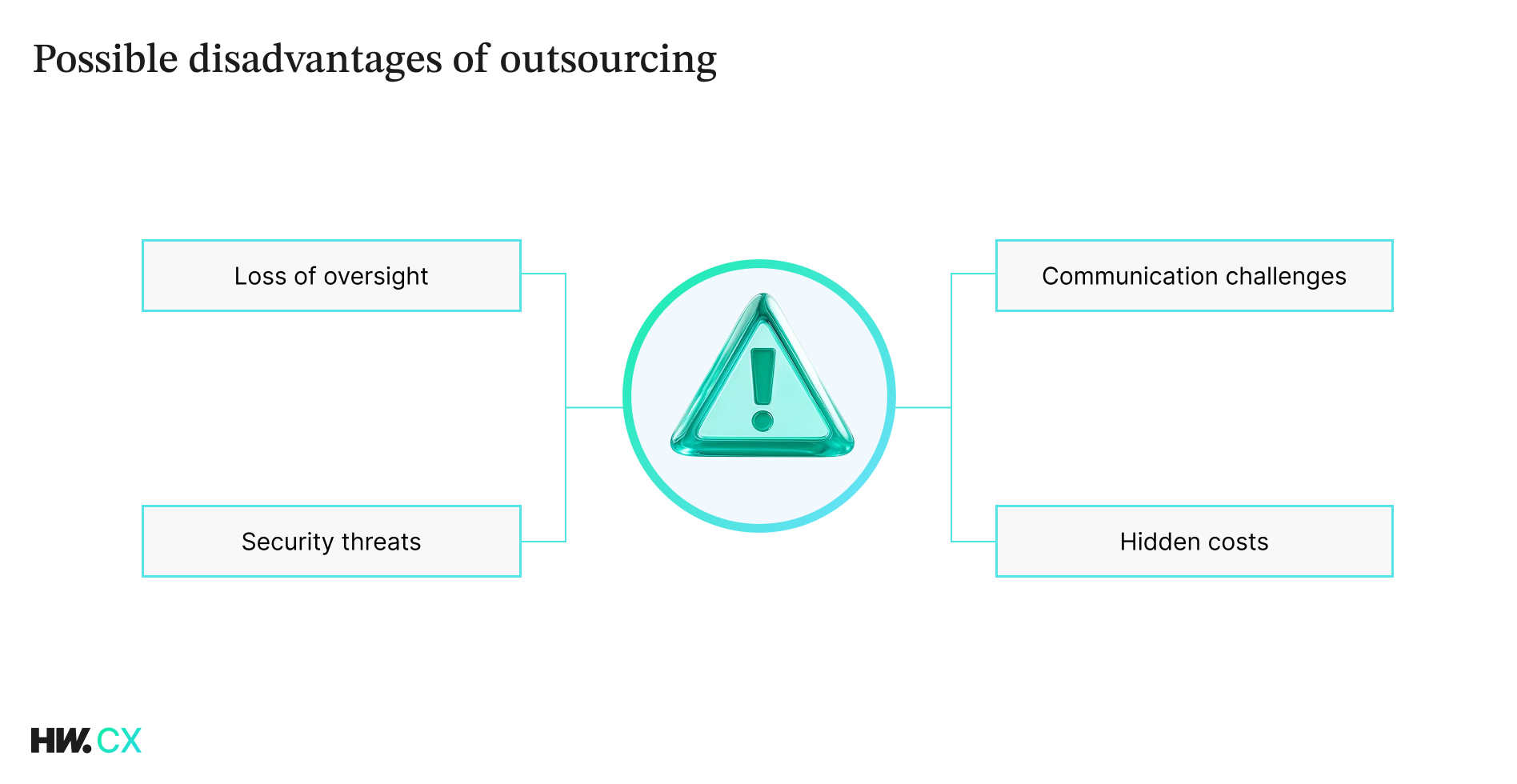
Here are some of the most basic outsourcing disadvantages:
Loss of oversight
Simply picking a reliable partner and stepping completely away from the process doesn’t work. You still need to know what’s going on and which processes you’ve outsourced. Your involvement is still required—just in a more hands-off way. The best partners get this and always provide the reports, stats, and data you need to track performance and analyze results effectively.
Security threats
What companies fear most, and rightly so, are security issues, the risk that confidential information could be exposed or accessed by the wrong people. Today, it is crucial to double-check whether your outsourcing partner meets the same security standards that you uphold internally. Of course, most outsourcing companies claim to be compliant with security protocols, but this is a matter that must be taken seriously.
Communication challenges
One of the main reasons companies outsource is to save costs by partnering with locations where labor and office space are cheaper, such as the Philippines, Mexico, or parts of Africa. This can create communication challenges due to different accents, languages, and cultural norms. Some issues, like accents, can be addressed with AI tools such as Accent Neutralization, while cultural differences require experience and expertise. The key is to choose partners with a proven track record and positive reviews who know how to navigate these challenges and keep collaboration smooth.
Hidden costs
One of the most common issues with outsourcing partners is hidden costs. A price may be quoted during sales calls, but later additional expenses appear for extra tools, training, or other unforeseen items. This can be very frustrating for businesses, as no one wants to pay more than expected. That is why it is crucial to clarify all potential costs upfront and make sure there are no unpleasant surprises down the line.
Explore Outsourcing Benefits with Helpware
As we move forward into a globally interconnected business environment, it is only logical that companies will be more able to focus on their core business, while allowing highly skilled third parties to be in charge of the tasks that are derived from their very own specialties. In other words, an outsourcing strategy allows both in-house and third-party talent to prioritize their strengths while letting others take care of their weaknesses.
As a people-centered BPM, Helpware is in a never-ending state of optimization. Both our specialists and the tech they deploy to satisfy our clients’ needs are constantly adapted to match the speed at which the market moves. This is the only way we can remain on top of such a competitive landscape.
By boosting the pros and diminishing the cons of outsourcing, our goal is to help companies of all sizes and industries accomplish their goals and keep on growing together in a relationship that feels like a close and devoted collaboration rather than a simple external agreement. Are you in?