
With ever-increasing globalization, software development outsourcing has become mainstream. A staggering 66% of US companies outsource at least one department, while 78% of businesses say they’re satisfied with their outsourcing partnerships. Given these trends, it should come as no surprise that the global business process outsourcing market is booming, valued at a whopping $415 billion in 2025 and projected to reach $491 billion by 2030.
More and more businesses are discovering the multiple benefits that custom software development outsourcing brings. From significant cost savings to ultimate flexibility unattainable with on-site product creation—outsourcing unlocks a world of opportunities you can capitalize on. However, it comes with certain nuances you should be aware of before delegating your project to a third-party vendor.
This article will explain them, helping you make sense of all things outsourcing. In the following paragraphs, you’ll learn:
- What is software development outsourcing?
- What types of outsourcing are there, and which one is better suited for your business needs?
- What advantages does this process bring to your business?
- What risks and challenges should you be aware of before outsourcing your project?
- What outsourcing models are there, and which one should you opt for?
- How to successfully outsource your project and find a reliable partner?
- How much is outsourcing going to cost?
- And other insights that will help you outsource with confidence.
As your trusted outsourcing partner, Helpware Tech wants to ensure you have the best experience with software development outsourcing and are aware of every possible challenge this process entails.
Without further ado, let’s dive right in!
What is software development outsourcing?
Software development outsourcing is a business practice that involves hiring a third-party partner to carry out specific development tasks on a contract basis. In software engineering, such tasks may include product discovery, quality assurance, UI/UX design, application maintenance and support services, end-to-end development, and more. Depending on the chosen cooperation model, your vendor can either take full responsibility for developing and managing your project or provide assistance without having direct control over project management. We’ll discuss this in detail later in the article.
Arguably, the most appealing benefit of outsourced software development for businesses is cost savings. Companies from the US, the UK, Canada, and other countries with high labor costs can save up to 60% on staffing expenses by outsourcing their projects to countries where labor is cheaper. However, as we’ll explore further below, outsourcing IT development is more than that. Apart from cost efficiency, it opens access to a global talent pool while enabling you to scale your team up and down on demand, avoid recruitment challenges, and bring your products to market faster.
Keep in mind that the outsourcing destination is the most important aspect of the process. The country you delegate your project to will affect development costs, time zone differences, communication, access to talent pools, and more. That’s why it’s critical to understand the three main types of outsourcing based on location: offshoring, nearshoring, and onshoring.
Offshoring, nearshoring, and onshoring: Which is the best option?
When it comes to outsourcing software development, you have three options: offshoring, nearshoring, and onshoring. What’s the difference between the three, and which one should you choose? Let’s explore together.
Offshoring
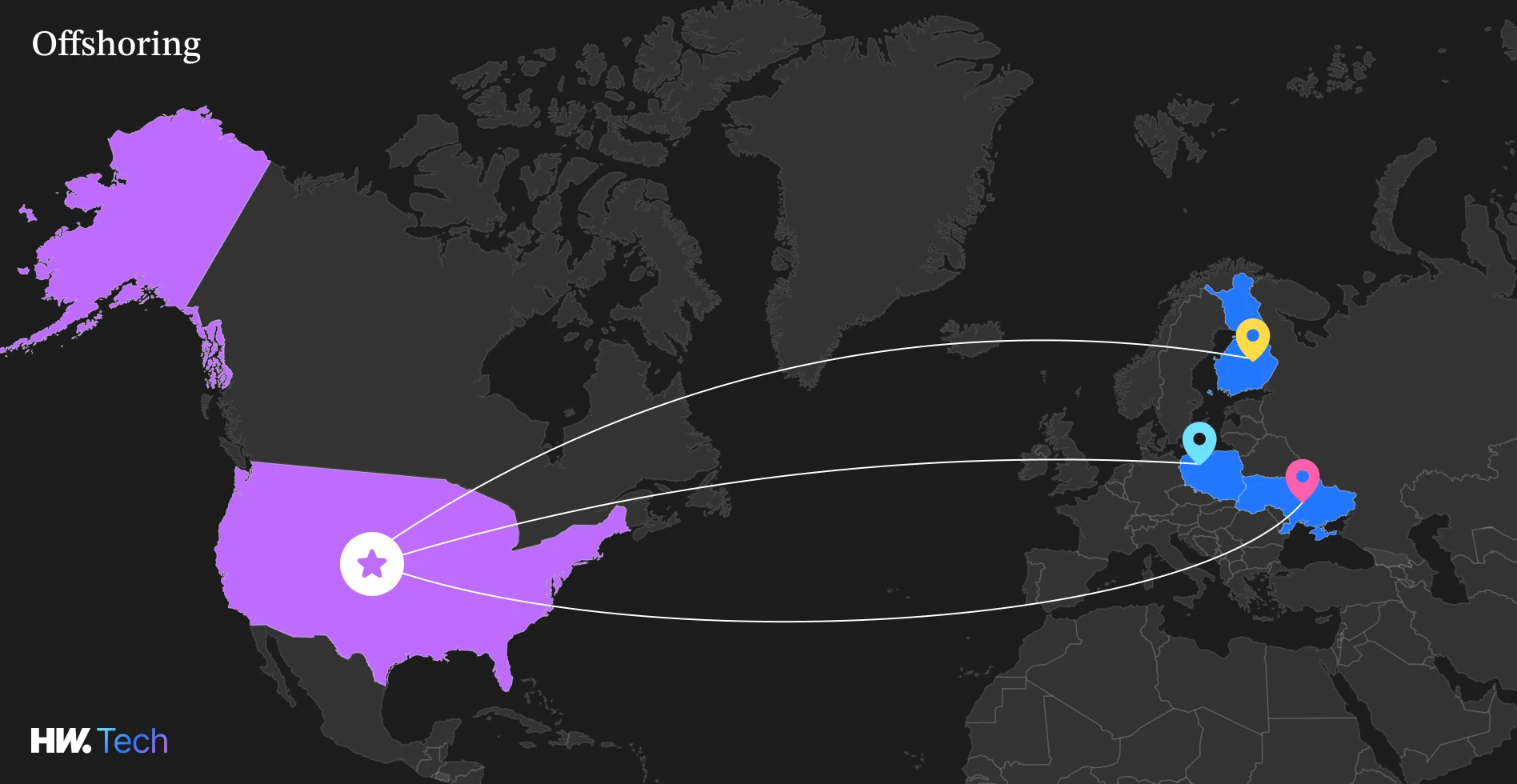
Offshoring is software development outsourcing to a distant country, one located on another continent. For example, if your company is based in the US, delegating your project to Ukraine would be considered offshoring. The biggest benefit of this approach is a major cost reduction: offshoring is the cheapest option of the three, which is why it’s attractive for startups and projects with shoestring budgets. Apart from that, offshoring opens access to a vast talent pool, so you can find even the rarest expertise while ensuring an optimal quality-to-price ratio.
Now let’s discuss the downsides of offshore software development. First, it comes with significant time zone differences (which may actually be a benefit, as you’ll learn later). These differences may hinder communication, as your team and the outsourced team will be working at different hours (with only 2-3 hours of overlap). You’ll also have to forget about in-person business meetings, as the huge distance between your countries and ensuing high travel costs will render them unlikely. Last but not least, you may encounter language barriers and cultural differences. However, the former is not widespread, as companies targeting Western customers typically hire IT experts with high English proficiency.
Pros:
- Cheapest option of the three.
- Vast talent pool to choose candidates from.
Cons:
- Significant time zone differences.
- In-person business meetings are unlikely.
- Language barriers and cultural differences may arise.
Best for: Startups and companies with tight budgets.
Nearshoring

Nearshore software development is an approach in which you outsource your project to a vendor in a neighboring country, or at least one located on the same continent. For example, if you’re based in the US, software outsourcing to Mexico would be considered nearshoring. This option offers the benefit of geographical proximity, suiting businesses seeking a balance between cost savings and easier collaboration. In addition, cultural differences will be less prominent compared to offshoring (however, it’s not always the case).
When it comes to the disadvantages, nearshoring is more costly than offshoring. The talent pool will also be somewhat limited to neighboring countries, which may be a deal-breaker for some organizations. What’s more, nearshoring doesn’t guarantee the absence of language barriers—they may still occur depending on the country you choose.
Pros:
- Geographical proximity facilitates collaboration and in-person meetings.
- Cultural differences are less prominent compared to offshoring.
- Great balance between cost savings and effective teamwork.
Cons:
- More expensive compared to offshoring.
- Language barriers may still arise.
- Talent pool is limited to neighboring countries.
Best for: Businesses that value teamwork but still want to save on product development.
Onshoring
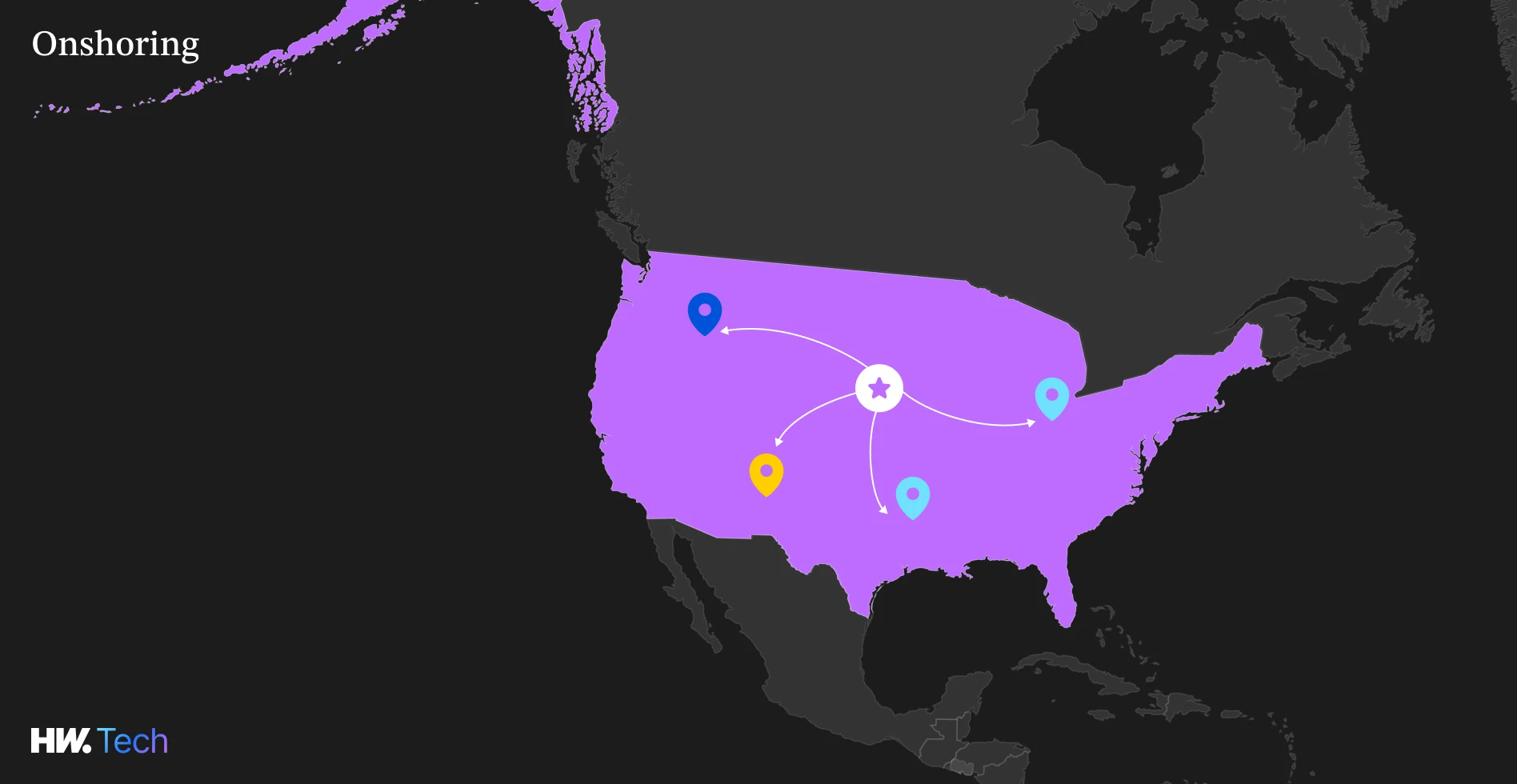
Onshoring involves outsourcing software development projects to a vendor in another city in your country—often one with lower labor costs. For example, if you’re based in Los Angeles, outsourcing to a team in Portland would be considered onshoring. This approach is the most expensive of the three; however, it guarantees full cultural alignment, the absence of language barriers, minimal to no time zone differences, and the closest geographical proximity. Besides, by onshoring, you support the local economy, which is a big deal.
Despite the above, onshoring is the least popular software development outsourcing option due to its high cost. If you live in the US, the UK, Canada, or any other country where engineering is expensive, onshoring won’t help you save money. Thus, it may not be the best approach for startups and projects with limited budgets. Furthermore, the talent pool is limited to one country, making finding relevant expertise a challenge.
Pros:
- Closest geographical proximity.
- No language barriers and cultural differences guaranteed.
- Similar time zones.
Cons:
- Most expensive option for countries with high labor costs.
- Talent pool is limited to one country.
Best for: Companies that prioritize cultural alignment, close communication, and control.
Benefits of outsourcing software development
Now that we’ve discussed the different approaches to software outsourcing, let’s talk about the advantages it brings to businesses.
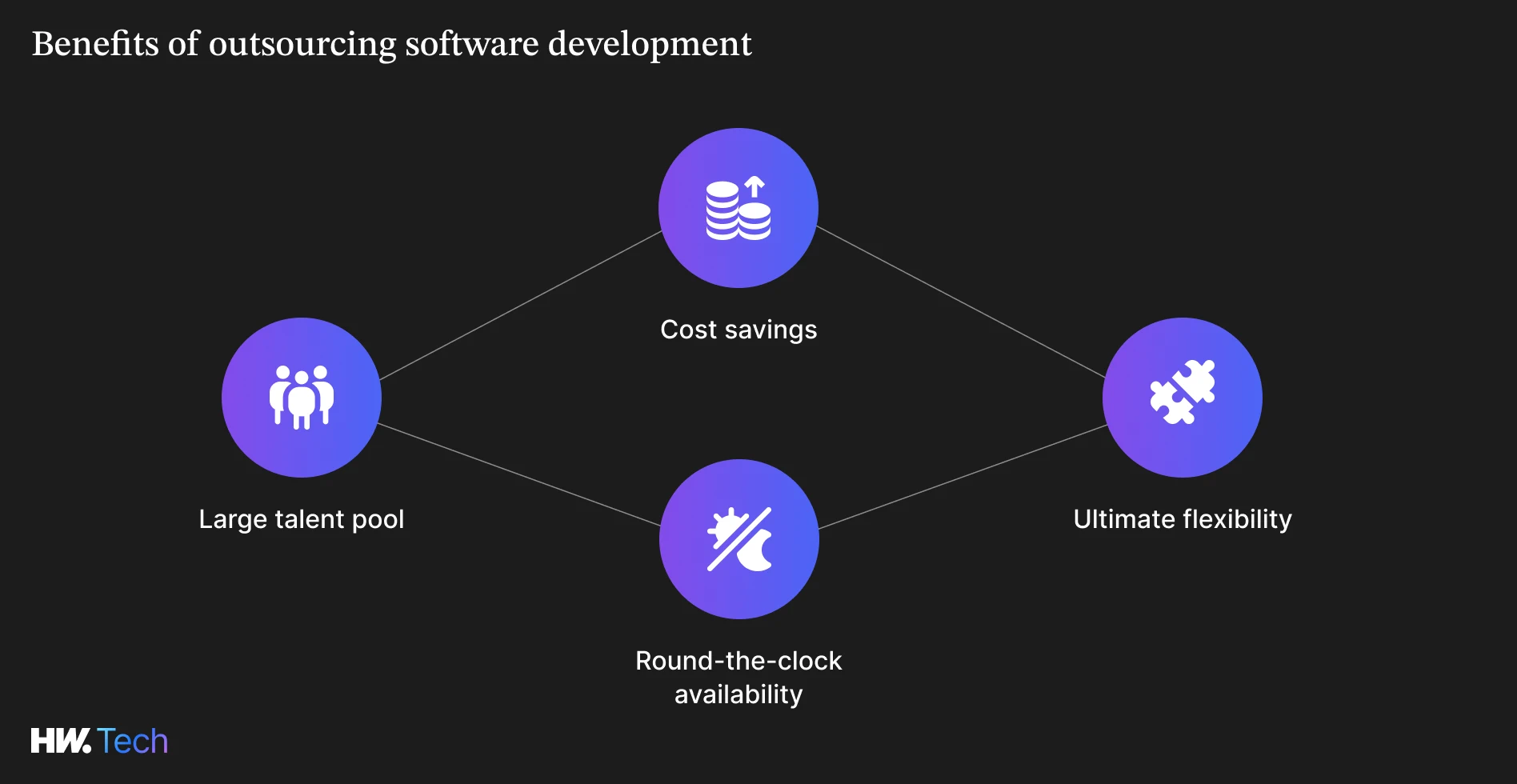
#1 Cost savings
The most significant (and obvious) benefit of outsourcing software developers is cost savings. So let’s start here.
As a wise business owner, you want to get the job done at the lowest possible cost. And it has nothing to do with stinginess. Startups and new projects often have limited budgets, so it’s only natural that you seek the most cost-effective approach. Unfortunately, however enticing on-site development might seem, it entails huge staffing costs. Start counting on your fingers:
- First things first, you have to pay software developers and IT experts competitive salaries to ensure they stick with you to the end.
- Don’t forget about employee benefits such as medical coverage, dental insurance, retirement planning, paid vacation time, paid sick leave, fitness reimbursement, and others.
- You also need to invest in recruitment services unless you plan to find software developers for your web app development or mobile app development project on your own. This involves the costs of advertising the job, using recruiting platforms, and paying recruiters for their time.
- Unless you want trouble, you must also pay taxes for each employee, including payroll taxes, social security, Medicare, and the like.
- To add more fuel to the fire, you need to purchase expensive equipment and provide your in-house team with the necessary infrastructure, including office space, computers, software licenses, and so on.
Sure thing, having your own in-house team is beneficial in many ways, allowing you to have full control over your project. But considering how costly it is, we wouldn’t recommend it to someone who’s just starting out and has limited resources.
Custom software development outsourcing, on the other hand, is much more cost-effective, saving you from large upfront investments. You will pay an hourly rate or a fixed fee for the services you use without obligations to provide benefits or other compensations. You won’t have to hire recruiters, pay taxes for employees, and purchase high-end equipment, which will significantly reduce your expenses.
Save up to 70% over in-house recruiting
Save thousands of dollars with our nearshore and offshore talent. We work as your in-house crew, but at a fraction of the cost.
#2 Ultimate flexibility
Another major benefit of outsourced software development is that it allows you to stay flexible and scale your team up and down on demand. You will be able to adapt to changing needs efficiently while minimizing development costs and other expenses.
Take this scenario. You’re working on a new product and want to market it quickly. To do that, you hire a large development team from Helpware Tech or another outsourcing company that turns your idea into life in a few months. Once your solution is released, you don’t need a large team anymore, so you scale it down, leaving only two or three developers to maintain and support your product.
If such a need arises, you can hire more software engineers in the future to help you with a new project. Let’s say you’ve identified a new market opportunity and want to react quickly to outperform your competition. Software development outsourcing allows you to hire new developers in a few days, without the delays associated with hiring and training in-house staff.
Obviously, this level of flexibility is unattainable with internal teams because you can’t just hire developers and then fire them on a whim.
#3 Large talent pool
Finding experienced developers in your country can be challenging, especially when it comes to rare expertise. With software outsourcing, you gain access to a global talent pool and tap into specialized skills that may not be available in your country. This means you can find the right talent for your project and ensure high-quality results regardless of geographical boundaries.
Considering the above, it’s not surprising that only 34% of companies cite lower costs as the main reason they opt for outsourced software development, while 42% are driven by improved access to talent. By outsourcing to Eastern Europe, for example, you access a vast talent pool of 1.5 million professionals that costs up to 3.5 times less than in the US. Another popular outsourcing destination for US companies is India, which produces over a million engineering graduates annually and offers even lower labor costs than Eastern Europe.
#4 Round-the-clock availability
Once again, outsourcing enables you to stay flexible and strategically choose the country you hire from. Let’s say you have a product that requires 24/7 availability, for example, an AI development project. To ensure round-the-clock support, you need several AI engineers who will work in shifts, keeping an eye on your solution for issues and emergencies.
Finding a software engineer for night shifts in your country would require paying night shift differentials, which range from 5% to 15% above the base hourly wage in the United States. To avoid it, you can hire a developer in a country with a different time zone, allowing them to work regular hours during their day while it’s nighttime in your country. Known as the “follow-the-sun” approach, it’s a common strategy to keep work flowing smoothly around the clock. As we mentioned above, sometimes time zone differences can be beneficial.
Possible risks and challenges of outsourcing software development
While offering substantial benefits, software development outsourcing comes with risks and challenges that you need to take into account.

#1 Intellectual property theft
Unfortunately, there have been numerous cases where dishonest and unreliable vendors have stolen their clients’ intellectual property.
In one case, a contractor with access to a critical customer database deleted the data from company devices and copied confidential information for personal use. If it hadn’t been for proper backup measures, the company would have lost its sensitive information and faced business disruption, reputational damage, and financial losses.
To avoid IP theft and successfully outsource software development, you need to conduct thorough vendor due diligence.
Mitigation tips:
✅ Screen outsourcing vendors thoroughly before signing a contract.
✅ Sign a non-disclosure agreement (NDA) to protect your IP legally.
✅ Give the outsourced team access only to the parts of your system they need for work.
#2 Project control concerns
Partial loss of control over project development is among the most common challenges in software outsourcing. When working on a project on-site, you’re in charge of everything and have full visibility into the development process. You can introduce changes on the fly and, most importantly, control the quality of your team’s work. With an outsourced team, it might not always be the case. You will likely have less direct oversight over its processes, quality, and timelines, which may lead to scope creep, delays, and deviations from business requirements.
However, if you choose HW.Tech as your software development outsourcing partner, you won’t have to worry about all this. We value transparent communication and keep our customers updated at every stage of product creation. You will be assigned a personal project manager who will be there for you to answer any questions you have. Our team goes beyond transactional client-vendor relationships, fostering strategic partnerships based on mutual trust and seamless collaboration. Contact us today and get seasoned developers for your project within 10 days.
Mitigation tips:
✅Establish clear communication channels and regular check-ins.
✅ Set clear expectations about quality standards and deadlines in the contract.
✅ Use Trello, Asana, Jira, or another project management tool to keep the work organized and track progress.
#3 Vendor lock-in
Vendor lock-in in software development outsourcing occurs when you are dissatisfied with your current provider but forced to stick with it because changing it is too costly, difficult, or impractical. So if you are too hasty in choosing an outsourcing partner, this might lead to dire long-term consequences. And don’t make the mistake of thinking that you can easily change the vendor if you aren’t happy with its service quality. It will likely be harder than you imagine because:
- You have to transfer project knowledge and documentation.
- The new vendor will need time to understand your product, its requirements, and codebase, which will cause delays.
- If your previous vendor used proprietary tools and technologies, replicating them will be hard or even impossible.
To make matters worse, there are often hefty penalties for early contract termination. So, once again, don’t rush when it comes to deciding who you are outsourcing development software to.
Mitigation tips:
✅ Choose a vendor with standardized technologies to facilitate a potential changeover.
✅ Review client testimonials on Clutch, Capterra, GoodFirms, and similar portals to get an idea of customer satisfaction with a potential partner.
✅ Maintain thorough and up-to-date project documentation to simplify knowledge transfer.
#4 Hidden costs
Whether you’re outsourcing software development, data science, or MVP development, no project is completely safe from hidden costs. Unforeseen expenses can creep up on you out of the blue, adding a financial burden that might affect project development. We’re talking about:
- Force majeure situations. Wars, natural disasters, and other acts of God might take place in your outsourcing partner’s country, causing disruptions and delays. At Helpware Tech, we maintain office presence in 18 countries worldwide, which enables us to quickly reroute operations and ensure business continuity even in the face of unforeseen events.
- Software and equipment updates. When outsourcing software development, factor in the need for software and equipment updates. Equipment tends to break down unexpectedly, and software becomes deprecated over time, entailing extra expenses.
- Project management costs. Managing remote teams isn’t easy and often involves hidden expenses such as tracking progress, coordinating across time zones, and resolving misunderstandings.
Mitigation tips:
✅ Always have a backup plan if something goes wrong.
✅ Establish clear communication to minimize misunderstandings and costly rework they cause.
✅ Allocate an emergency budget.
Software development outsourcing models: Choose the right fit for your project
You can outsource software development using one of the following engagement models: Fixed price, time and materials, dedicated team, and staff augmentation. Let’s review each option in more detail.
Fixed price
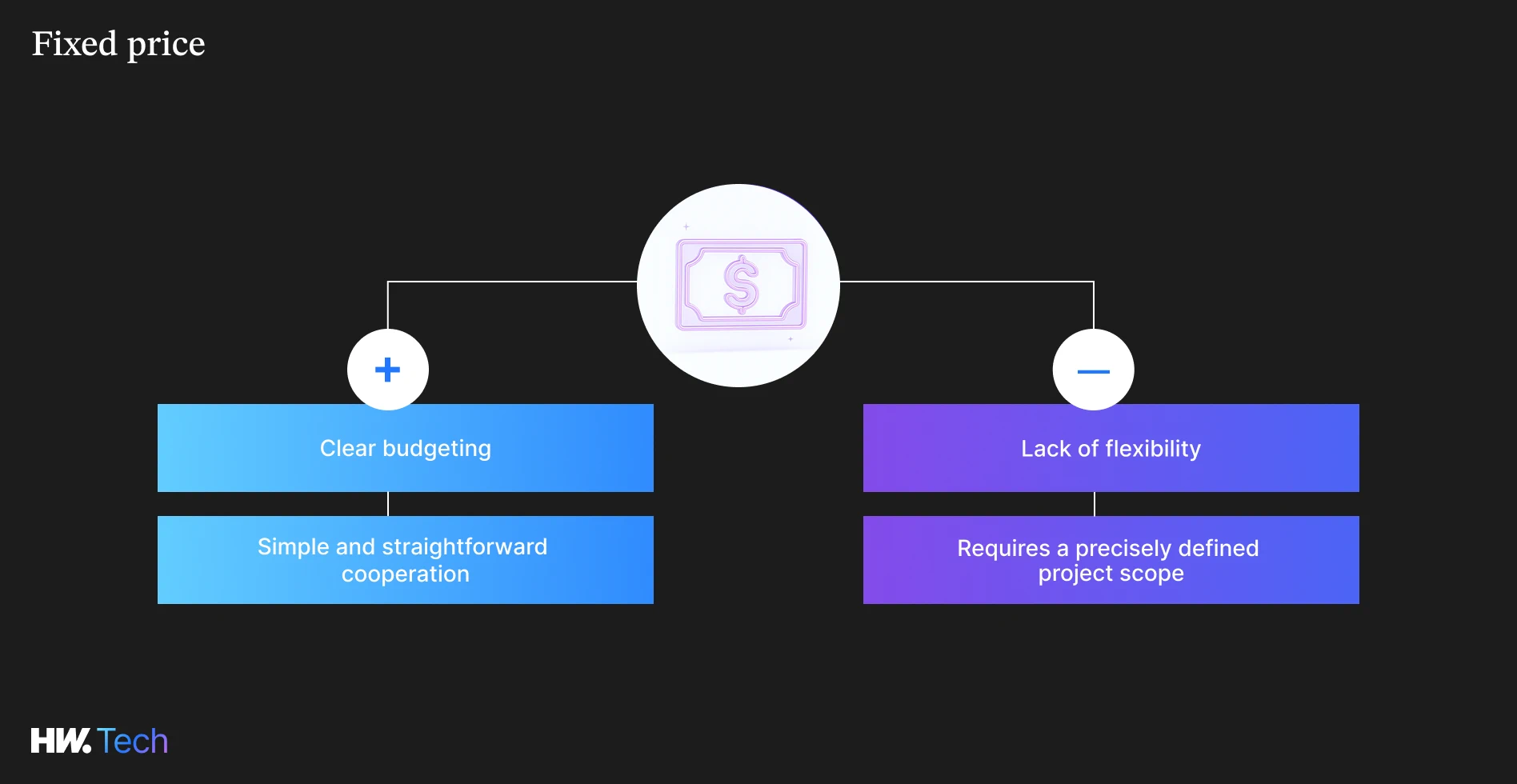
A fixed price contract is an agreement with a predetermined value for the services provided. In simpler terms, it means that both parties (you and your software outsourcing partner) agree on the specifications, project scope, and cost in advance. This engagement model is straightforward and predictable in terms of budgeting, making financial planning easier. However, it lacks flexibility—any deviation from the initial scope will result in additional charges. That’s why a fixed price contract works best for well-defined projects with clear requirements.
Pros:
- Clear budgeting.
- Simple and straightforward cooperation.
Cons:
- Lack of flexibility.
- Requires a precisely defined project scope.
Best for: Well-defined projects with clear requirements.
Time and materials
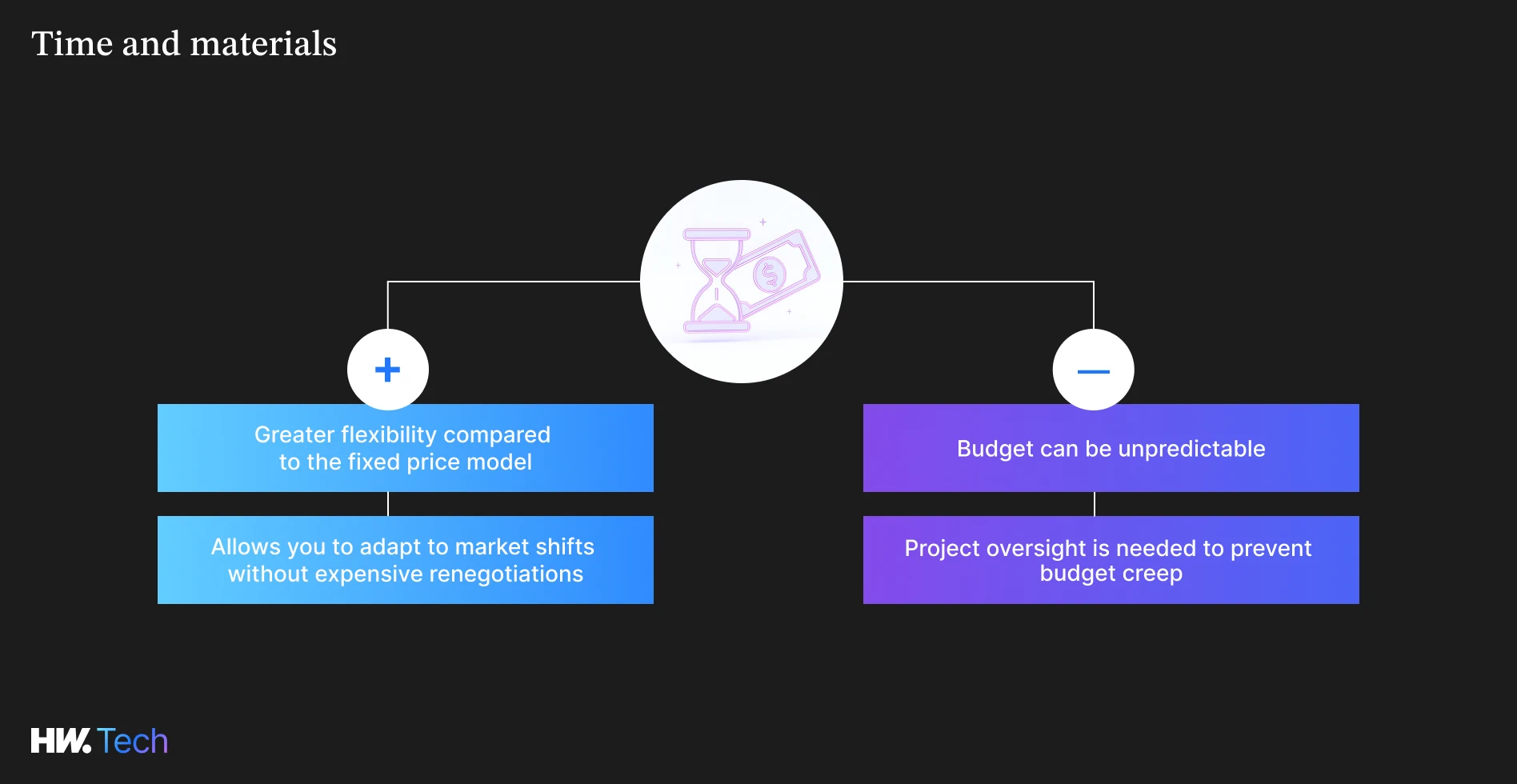
As the name suggests, with a time and materials contract, you cover the actual time the outsourced team spent on the project and any material expenses, such as cloud services, project management tools, development solutions, and so on. Unlike the fixed price model, the time and materials approach offers greater flexibility, allowing you to adapt on the fly without expensive and time-consuming renegotiations. However, budget planning gets challenging, as the total cost can be unpredictable. Besides, some oversight is needed to keep the budget in check.
Pros:
- Greater flexibility compared to the fixed price model.
- Allows you to adapt to market shifts without expensive renegotiations.
Cons:
- Budget can be unpredictable.
- Project oversight is needed to prevent budget creep.
Best for: Small and medium-sized projects without predefined requirements.
Dedicated team

In this model, your vendor builds a dedicated team of software engineers and IT experts to work exclusively for your project. It becomes an extension of your in-house team or serves as a full replacement, carrying out development, design, testing, application modernization, and maintenance tasks. You, in turn, cover monthly salaries, the vendor’s service fee for overhead (recruitment, infrastructure, etc.), and sometimes extra costs (software licenses, equipment, travel, and so on). One of the biggest benefits of the dedicated team approach is that it offers full control over project development, similar to that with internal teams. It is ideal for long-term projects and businesses that want to avoid the overhead of full-time hiring.
Pros:
- Long-term engagement.
- Full-time commitment to your project.
- High level of control and transparency.
Cons:
- Higher upfront investment.
- Requires hands-on project management.
- Not suitable for short-term projects.
Best for: Long-term projects that require consistency.
IT staff augmentation

Under the IT staff augmentation model, your vendor provides software engineers and information technology experts to bridge talent gaps in your team. They work alongside your in-house employees, extending your team’s expertise and helping during workload spikes. With that in mind, this approach suits businesses that already have established in-house teams but seek specific technical expertise to address immediate project needs. IT staff augmentation contracts typically don’t have minimum commitment periods, which is why they work well for short-term projects and companies aiming to scale their teams quickly.
Pros:
- Scaling flexibility.
- You have full control over the project.
- Fast access to rare expertise.
Cons:
- Requires internal management and oversight.
- Integration with in-house teams can take a while.
- You’re responsible for project outcomes.
Best for: Short-term projects and companies that want to scale flexibly.
Translate your idea into a tangible product
We'll turn your concept into a robust solution that resonates with your target audience.
How to outsource software development: Your step-by-step guide
Now that we’ve discussed different types of software development outsourcing, the process’s benefits and risks, and common engagement models, let’s talk about how to outsource software development successfully. Below, you will find a step-by-step guide that will help you navigate outsourcing with confidence.
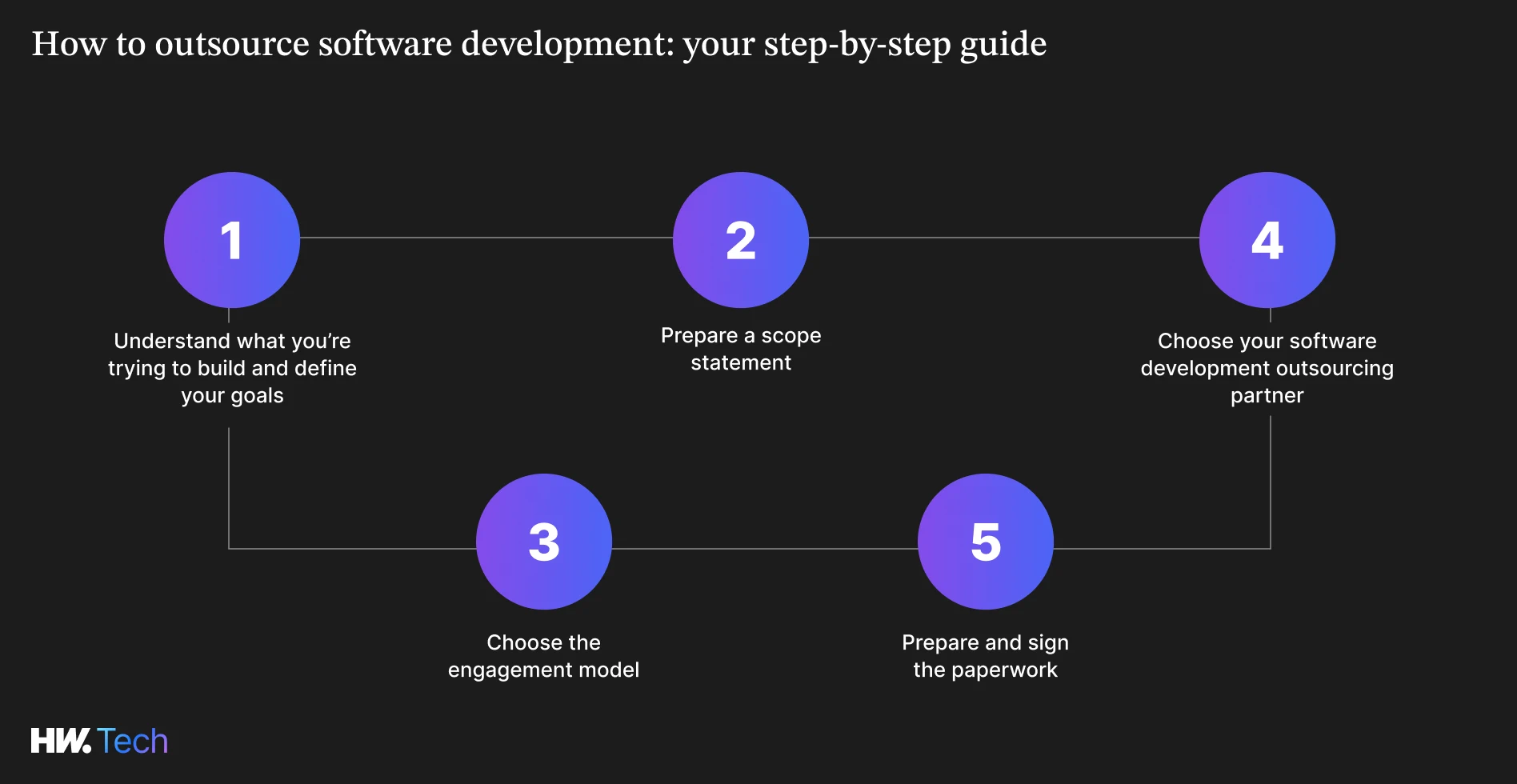
#1 Understand what you’re trying to build and define your goals
When it comes to outsourcing software development, the first thing you must have is clarity regarding what you’re trying to build. This critical prerequisite will help you clearly communicate your product vision and requirements to the vendor, increasing the likelihood of the project’s success. So before searching for the top custom software development outsourcing company, define your goals and objectives. That way, you’ll avoid misunderstandings and scope creep.
If your product vision and project goals are vague, try asking yourself the following questions:
- What problems does my product aim to solve?
- Who is its target audience?
- What core features will my solution need to be successful?
- How can I measure if the product is successful or not?
- What technology will I base my software on?
- What is my budget and timeline?
- Do I want to fully control project management or delegate it to the provider?
Answering these questions thoroughly will set a solid foundation for your outsourcing journey and ensure that your requirements will be understood.
#2 Prepare a scope statement
A scope statement will lay the groundwork for your project roadmap and help you avoid scope creep. Prepare this document and make sure it includes:
- Project objectives. Clearly define the high-level goals of your software project, including the target audience and the problems the software aims to solve. Identify your business process automation needs (if any).
- Project deliverables. List what you want to achieve after each sprint (if you use an Agile approach), or what the final results should be by the end of the project. Also, decide if you want to start with an MVP.
- Out-of-scope items. Outline what the project will NOT cover to prevent scope creep and avoid wasting budget and resources on unnecessary features.
- Project constraints. Define critical constraints: project start date, estimated timelines for MVP and full product launches, key milestones, budget limits, and any regulatory requirements that the outsourced team must comply with.
- Hourly price estimate. Include an estimate of the total hours needed to complete the project along with an affordable hourly rate for outsourcing services.
- Approvals. Document the list of all stakeholders involved, their roles, and the approval status of the project scope to ensure full alignment.
#3 Choose your software development outsourcing partner
To successfully outsource software development, you need to find a reliable and trusted partner that will treat your project as its own. When exploring your options, consider:
- Outsourcing country. Where your outsourcing partner is located has a big impact on development costs, communication, and time zone differences. While it might be tempting to choose the country with the lowest labor costs, it’s important to also consider these other factors. For US companies, some of the most popular outsourcing destinations are Ukraine, India, Brazil, the Philippines, and Romania. These countries have well-established IT sectors with an adequate price-to-quality ratio.
- Company size. How big is the company you want to outsource your project to? Does it have enough developers to deliver what you need on time? Outsourcing software development for startups and for well-established enterprises is quite different—the former typically need small, flexible teams, while the latter often require larger, more structured teams to handle complex requirements.
- Case studies. Dedicate some time to exploring the company’s finished projects. Ideally, it should have experience in developing solutions similar to the one you want to create. Look for real results, client feedback, and any challenges they’ve tackled—it’ll give you a clearer picture of what to expect.
- English proficiency. Software development requires nuanced discussions about the process, planning, design, and other complex stages. That’s why you should choose a team with a high level of English proficiency..
- Reviews. Check reviews on specialized portals such as Clutch, Capterra, GoodFirms, and the like. This will give you an idea of the company’s reputation and customer satisfaction.
- Expertise and skillset. Ensure the company has the technical expertise and experience in the specific technologies required for your project (AI, computer vision, LLM development, etc.). Check their tech stack and past projects to see if they’ve worked with similar tools before. A team that’s up to date with the latest trends will bring more innovative solutions to the table.
Apart from the above, you should also take into account:
- A vendor’s development infrastructure (hardware, network, bandwidth, etc.).
- The maturity of project management, quality management, and security management processes (demonstrated through ISO 9001 and ISO 27001 certificates).
- Compliance with industry standards and regulations you need to follow (HIPAA, FDA, PCI DSS, and others).
- Pricing options offered (fixed price, T&M).
Select a few candidates and conduct demo calls to get to know them better. That will help you choose the right provider. Once you have found your partner, decide on the engagement model.
#4 Choose the engagement model
Since we’ve already covered engagement models in software development outsourcing, we won’t delve deep into them here. But let us repeat the key points.
You can outsource your project using one of the four approaches:
- Fixed price—you pay a fixed fee for the work. Works best for projects with defined requirements and clear scopes.
- Time and materials—you pay for the time and resources the outsourced team spends on your project. This model is more flexible and suits companies with evolving requirements.
- Dedicated team—you hire a team dedicated exclusively to your project. Ideal for companies with long-term initiatives that require consistency.
- IT staff augmentation—you bridge skill gaps in your team by hiring external talent with the required expertise. Perfect for businesses that need to address immediate project needs without the hassle of in-house hiring.
Choose the engagement model carefully, as it is crucial to ensure your project runs smoothly and meets your specific business needs.
#5 Prepare and sign the paperwork
To protect your intellectual property and make sure everything runs smoothly, you and the vendor should work together to prepare and sign essential documents before kicking off the project. In software development outsourcing, these include:
- Non-disclosure agreement (NDA)—protects confidential information shared between you and the vendor; ensures your IP isn’t disclosed to a third party.
- Master services agreement (MSA)—outlines basic terms and conditions defining the long-term relationship between you and the provider; covers payment terms, project audits, dispute resolution, etc.
- Service level agreement (SLA)—defines the expected level of service; outlines key performance indicators (KPIs), backup and recovery protocols, as well as terms for support, maintenance, hosting, infrastructure, and development.
- Statement of work (SOW)—defines expectations for deliverables; includes a project overview, unique selling points, detailed deliverables, development and deployment timelines, a breakdown of the software development stages, and other relevant project specifics.
How much does software development outsourcing cost?
After learning how to outsource software development, the next logical question is, how much is it going to cost? Well, there is no simple answer because several factors come into play and influence the price of this service:
- Outsourcing destination.
- Hourly rates your partner charges.
- Project complexity and estimated hours to complete it.
- Team size and composition.
- Engagement model.
- Technology stack.
- Product quality requirements.
- Potential extra expenses (communication tools, travel, software subscriptions).
However, a basic answer doesn’t offer the clarity you need to make informed decisions. To provide a more accurate estimate, let’s consider three common outsourcing scenarios: discovery workshop and Proof of Concept (PoC) development, team extension, and full-scale project development.
Discovery workshop and PoC development
Discovery workshop and PoC development is the right choice if you need to validate your idea before diving headfirst into full-scale development. At Helpware Tech, we offer fixed-price discovery packages to suit different business needs:
| Deliverables | Workshop | UI/UX Discovery | Tech Discovery | Full Solution Discovery |
|---|---|---|---|---|
| Stakeholder Interview Summaries | ✔ | ✔ | ||
| Business Objectives & Goals Document | ✔ | ✔ | ||
| Problem Statement & Opportunity Analysis | ✔ | ✔ | ||
| Scope Definition & Requirements List | ✔ | ✔ | ||
| Basic Wireframes | ✔ | ✔ | ||
| User Research Report | ✔ | ✔ | ||
| User Personas & Empathy Maps | ✔ | ✔ | ||
| User Journey Maps & Experience Flows | ✔ | ✔ | ||
| Clickable UI Prototypes | ✔ | ✔ | ||
| Mood Boards & Style Guides | ✔ | ✔ | ||
| Information Architecture & Sitemap | ✔ | ✔ | ||
| Design System & UI Component Library | ✔ | ✔ | ||
| Technical Feasibility & Risk Assessment | ✔ | ✔ | ||
| System Architecture Diagrams | ✔ | ✔ | ||
| Tech Stack Evaluation & Recommendations | ✔ | ✔ | ||
| Data Models Integration & API Specs | ✔ | ✔ | ||
| Scalability, Performance & Security Analysis | ✔ | ✔ | ||
| Technical Debt & Maintenance Strategy Document | ✔ | ✔ | ||
| $5,000 | $10,000 | $10,000 | $20,000 |
Team extension
As mentioned above, the team extension (staff augmentation) model will suit you if you already have an established development team but need specific technical expertise to address immediate project needs and bridge talent gaps. Under this engagement, you pay an hourly rate for the hired candidates, which varies depending on their specialization, seniority level, and location. At Helpware Tech, we provide junior-, middle-, and senior-level IT experts from the Philippines, Eastern Europe, Western Europe, and Latin America:
| Specialization | Hourly Rate |
|---|---|
| Data Analyst | $26–$63 |
| Business Analyst | $15–$59 |
| Data Engineer | $34–$75 |
| Data Scientist | $23–$80 |
| Cloud Architect | $66–$99 |
| DevOps | $32–$85 |
| Project Manager | $23–$59 |
| QA Engineer (Automation) | $29–$65 |
| QA Engineer (Manual) | $12–$48 |
| UI/UX Designer | $31–$55 |
| Software Engineer | $12–$76 |
Multiply the hourly rate by the number of hours needed for your project to get an estimated total cost for each specialist.
Full-scale project development
Now let’s estimate the cost of full-scale project development. Suppose you have a project that takes 480 hours to complete. To turn your idea into a tangible software product, you need a project manager, a business analyst, a frontend developer, a backend developer, a DevOps engineer, a UI/UX designer, and a QA engineer (manual). For simplicity, let’s use the average hourly rate for each specialist:
- Project manager ($41/hour)
- Business analyst ($37/hour)
- Frontend developer ($44/hour)
- Backend developer ($44/hour)
- DevOps engineer ($58/hour)
- UI/UX designer ($43/hour)
- QA engineer ($30)
To calculate the total cost of the project, we need to add up the average hourly rates and multiply the sum by 480 project hours:
(41 + 37 + 44 + 44 + 58 + 43 + 30) × 480 = 142,560
Therefore, the estimated total cost of the project is $142,560.
Of course, this is just an estimate—your actual costs may vary depending on your specific needs, timelines, and team composition. If you would like to receive a custom quote for your project, feel free to contact us via the website form and share some details. We’ll get back to you within one business day to organize a scoping call and discuss the specifics.

Outsource your software development project to Helpware Tech
If you’re looking for a reliable software development outsourcing partner, Helpware Tech is ready to be that partner for you. With more than 20 years in business, our company has established itself as a trusted outsourcing vendor, empowering businesses on a global scale with impactful solutions that change the world for the better.
Backed by a portfolio of over 200 diverse projects, we have hands-on experience even with the most complex software solutions and development challenges. Our team is well-versed in all major programming languages and frameworks, delivering projects of any scale and complexity. Whether it’s cloud consulting, end-to-end development, or cybersecurity services, we’ve got you covered.
What’s more, we provide software development outsourcing benefits you won’t find elsewhere:
- Onboarding within 10 business days. You’ll receive the first CV within 5 days, with senior-level developers ready to start in as little as 10 days. That way, you can bring your product to market faster and outpace the competition.
- 60% cost savings. We help you reduce hiring expenses by up to 60%. With us, you save on employee benefits, training, equipment, office space, and payroll taxes. You can interview the candidates yourself or delegate this process to us.
- 14-day trial with a 20% discount. We offer a 14-day trial program so you can properly assess the provided candidates. Plus, you’ll receive a 20% discount during the trial. If a candidate doesn’t meet your requirements, we’ll replace them free of charge within 5 days—and the number of replacements is unlimited.
- Top 1% LATAM & Philippines tech talent. With Helpware Tech, you gain access to 5000+ pre-vetted top-tier talents with market-specific expertise from Latin America, Asia, and Europe. We empower you to maximize your budget while maintaining top-notch service quality.
- 18 locations. We have an office presence in the Philippines, the US, Ukraine, Poland, Switzerland, Germany, the United Kingdom, and many other countries. This enables us to build teams with market-specific expertise and a strong cultural fit.
93% of our customers are satisfied with our software outsourcing services, and 80% choose to partner with us again. Join their ranks—contact us today to translate your product vision into a tangible solution.
Conclusion
Outsourcing software development projects is a prudent and effective strategy. Although it may offer less direct control over project management compared to in-house development, it makes up for that by reducing costs, providing access to a global talent pool, and enabling businesses to stay flexible in ever-changing market conditions.
Software outsourcing caters to the needs of businesses of all sizes, offering flexible engagement models and plenty of destination options. You can choose onshoring for local collaboration and easy communication, nearshoring to leverage talent in nearby time zones with cultural similarities, or offshoring to tap into cost-effective expertise from distant regions. Ways to optimize your project’s efficiency and budget are numerous—all you have to do is decide what works best for you.
Follow this guide to navigate software development outsourcing with confidence. We hope our article has been useful and you’ll build the next game-changing product with a reliable partner by your side.