Explore the full range of solutions Helpware divisions provide:


Explore the full range of solutions Helpware divisions provide:

Our client is a specialized healthtech platform company that provides integrated software and services for medical providers, focusing on optimizing revenue cycle management (RCM) and claims submission processes for Medicare Advantage and private payer systems. The complexity of multiple payer rules and the sheer volume of claims and supporting documents (invoices, Explanation of Benefits (EOBs), medical reports) were impacting their ability to scale.
The client’s existing AI model for claims automation, built on traditional OCR, had low confidence and required extensive manual intervention.

Helpware deployed a specialized AI Training Data-as-a-Service (TDaaS) framework to transform the client’s revenue cycle management (RCM).
Helpware established a dedicated team to support the client’s back-office operations:
This team’s initial function was to handle the most critical, complex documents that legacy systems could not process, focusing on tasks like data extraction from medical records and accurate payment posting.

To move beyond reactive support, Helpware partnered with the client to implement a dedicated TDaaS framework centered on automated data labeling and a superior feedback loop, feeding the client’s internal AI claims engine.
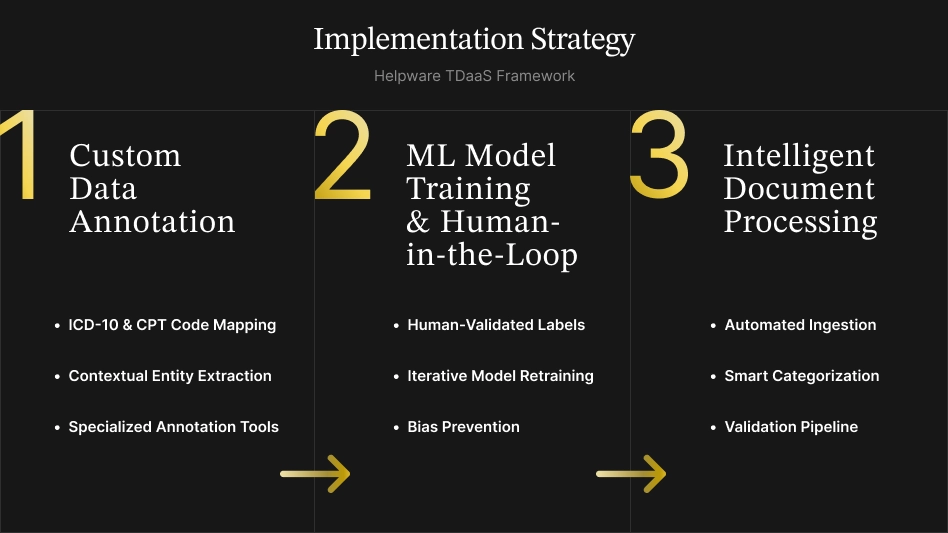
1. Custom Data Annotation: Instead of generic data entry, the Helpware team used specialized annotation tools to provide precise, high-volume labeling of key fields in complex documents (e.g., invoices and EOBs). This included training the AI on nuances like:
a. ICD-10 and CPT Code Mapping: Labeling codes within the text of medical reports for high-accuracy extraction.
b. Contextual Entity Extraction: Accurately identifying the Date of Service and Total Billed Amount regardless of where it appeared on the document layout.
2. ML Model Training & Validation (Human-in-the-Loop): The high-quality, human-validated data labels were fed directly back into the client’s Machine Learning model for iterative retraining. The Data Operations Engineers served as validators (the Human-in-the-Loop or HITL layer) to ensure compliance and avoid introducing bias, adhering strictly to payer-specific rules and HIPAA standards.
3. Intelligent Document Processing (IDP) Integration: By automating the ingestion, extraction, categorization, and validation of claims-related data, the workflow eliminated manual touchpoints for simple claims. This allowed the human team to focus solely on the 20% of high-complexity, low-confidence claims, maximizing efficiency and model training value.
The TDaaS solution rapidly transformed the client’s RCM operations, turning data processing from a bottleneck into a core efficiency driver.
| Metric | Before TDaas (Manual) | After Helpware TDaaS | Breakthrough |
|---|---|---|---|
| Manual ReviewVolume | 80% of documents | 20% of documents | 75% Reduction in Manual Labeling |
| Time-to-Adjudication | 12 Days | 4 Days | 67% Faster Processing Time |
| Data Accuracy | < 95% | 99.9% | Near-Zero Error Rate |
The client achieved a 75% reduction in the volume of documents requiring manual labeling, allowing the Data Operations Engineers to manage a 40% increase in overall claims volume during their peak season without adding headcount. The automated, high-accuracy data now ensures cleaner claim submissions and improves cash flow.